— FOOD
The 30-day pantry: an honest method that doesn’t feel like prepping

— ON THIS PAGE
A 30-day pantry is the honest first step in food security. Most households should aim there first, prove the discipline of rotating it, and only then decide whether to extend to ninety days, six months, or further.
On this framing, it is the practical entry point — not the deep end. That is a different framing to the one most preparedness writing leads with. The genre treats food storage as binary — either you have a year of food or you have nothing — and tells you, often noisily, that anything less than the full apocalypse plan is a failure of seriousness. This framing is wrong, and it is precisely what puts most thoughtful people off the topic. The serious answer is gradient, not binary. A pantry that you actually have, that fits your kitchen, that you actually rotate through, and that you can actually cook from, is a meaningfully better outcome than a year of mylar-bagged wheat berries that you bought once and never opened. Food security is a spectrum, and the honest engagement with it begins at the front of the spectrum, not the back.
This piece works the spectrum from a working 30-day pantry to a 90-day pantry to the year-of-food question. It is the discipline; everything beyond is iteration on it. We give real costs in current rand, real storage volumes, real failure modes, and real food — the kind people actually eat — at each tier. The aim is to leave you with a defensible answer to “how much food do we keep, and why?” that you could explain to a sceptical friend without embarrassment.
Why the year-of-food framing fails most people
Walk into a typical preparedness shop, online or in person, and the products on offer are not designed for the entry tier — they are designed for the deep end of the spectrum: 25-year mylar-bagged wheat, freeze-dried emergency buckets, MREs of debatable nutritional value and indisputable awfulness on the palate. They are sold with imagery of bunkers, with copy about decades of stored survival, with implicit appeals to scenarios most households are not actually planning for.
There are three honest problems with this framing.
The first is that it inverts the probability ladder. The realistic disruptions a household will face — job loss, a three-week supply chain disruption, a serious illness in the family, a sustained grid event, a regional flood — are addressed by thirty days of normal food, not by a decade of survival rations. Planning for the cinematic disaster at the cost of the everyday one is the same error we identified in our piece on threat assessment for your home and property — and it produces the same result, which is a household that feels prepared without being prepared.
The second is that long-term-only food rotates poorly and tastes terrible. A pantry you do not eat from is a pantry you do not learn from. The first time you actually cook your stored food is the worst possible time to discover you don’t like it, that your household won’t eat it, that your stove can’t handle it, or that the bag of dried beans that has sat for five years takes thirty hours to soften and has the texture of pebbles when it’s finally done.
The third is that the deep-end products are expensive per kilojoule of stored food, and they’re more expensive than they look. A bucket of freeze-dried meals priced at R3,500 typically holds far less actual food than the brochure photograph implies — the cost per real meal is several times what the same meal would cost from a normal supermarket. Cost-per-day is the honest unit, and on that unit, supermarket food rotated correctly beats survival-bucket food on every reasonable comparison except shelf life. Shelf life matters less than rotation discipline, which matters less than whether the household will actually eat what’s been bought.
We are not arguing that long-term staples are useless. They are useful — at the right tier of the spectrum, for the right reason, in the right household. They are not the place to start.
The supermarket method
The 30-day pantry, done honestly, looks nothing like a survival-prepper’s stockpile. Done honestly, it looks like a slightly oversized version of a household kitchen that the household actually uses. It looks like a slightly bigger version of a normal household’s kitchen — more shelf space, more visible labelling, a clearer rotation rhythm, and slightly larger pack sizes for the staples that anchor most meals. The food is food you actually eat. The discipline is rotating through it on a sustained cycle so that nothing goes off, nothing gets forgotten, and nothing turns into a Saturday-morning archaeology project.
We call this the supermarket method, because the 30-day pantry is built — and rebuilt — at the same supermarket you already shop at, on the rhythm you already shop on, with the food you already cook with. There is no special trip for it. There is no specialist supplier. There is no bunker aesthetic. It is the household’s normal kitchen, with thirty days of buffer instead of seven.
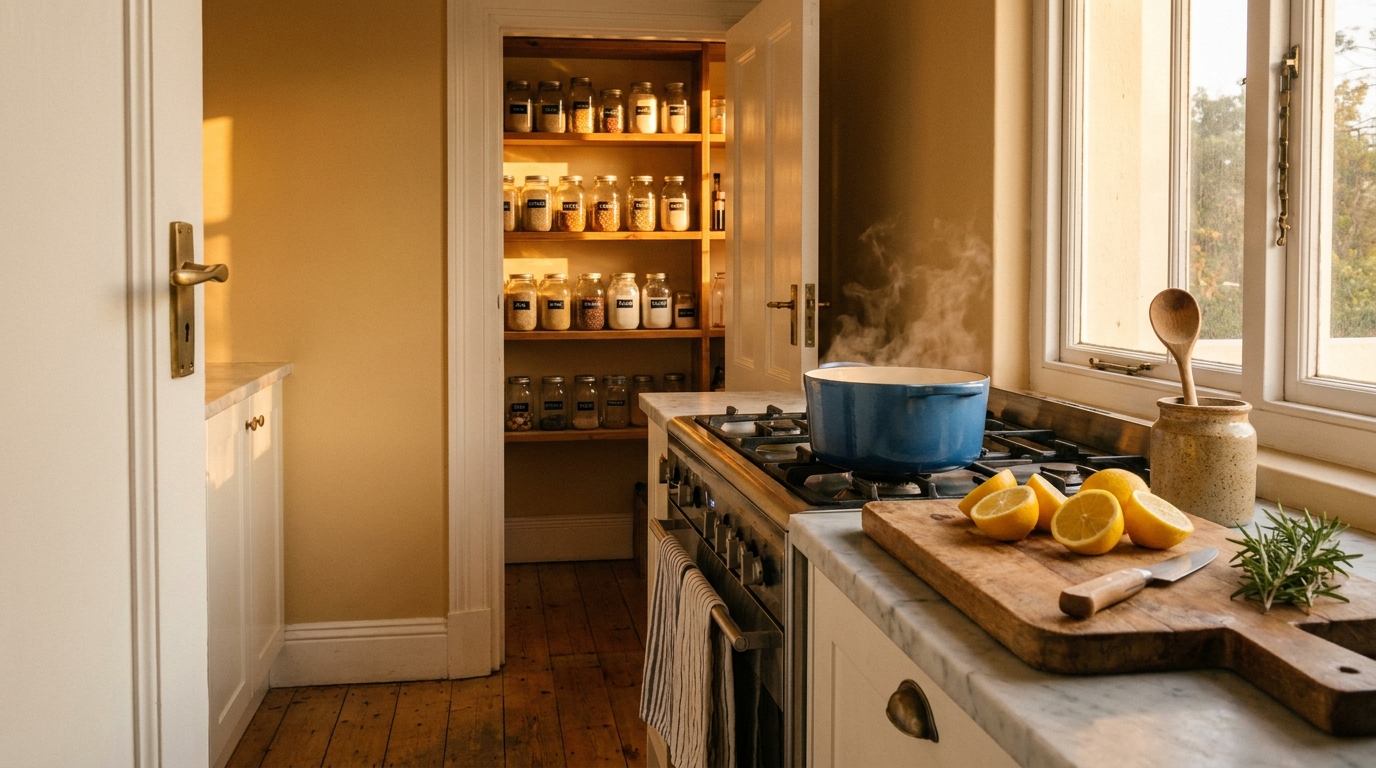
The mechanics, simplified to four rules:
- Buy what you eat. Rotate what you buy. Anything stored that you wouldn’t normally buy is dead weight on a shelf. The whole point of the supermarket method is that the pantry doubles as the household’s everyday kitchen — which means everything in it earns its keep by being used.
- Buy slightly larger pack sizes for staples. A 5 kg bag of rice instead of 1 kg. A 2.5 kg bag of mealie meal instead of 1 kg. A 750 ml oil instead of 250 ml. The economics already favour this, even ignoring storage; the supermarket method is partly about catching the savings the household was already entitled to.
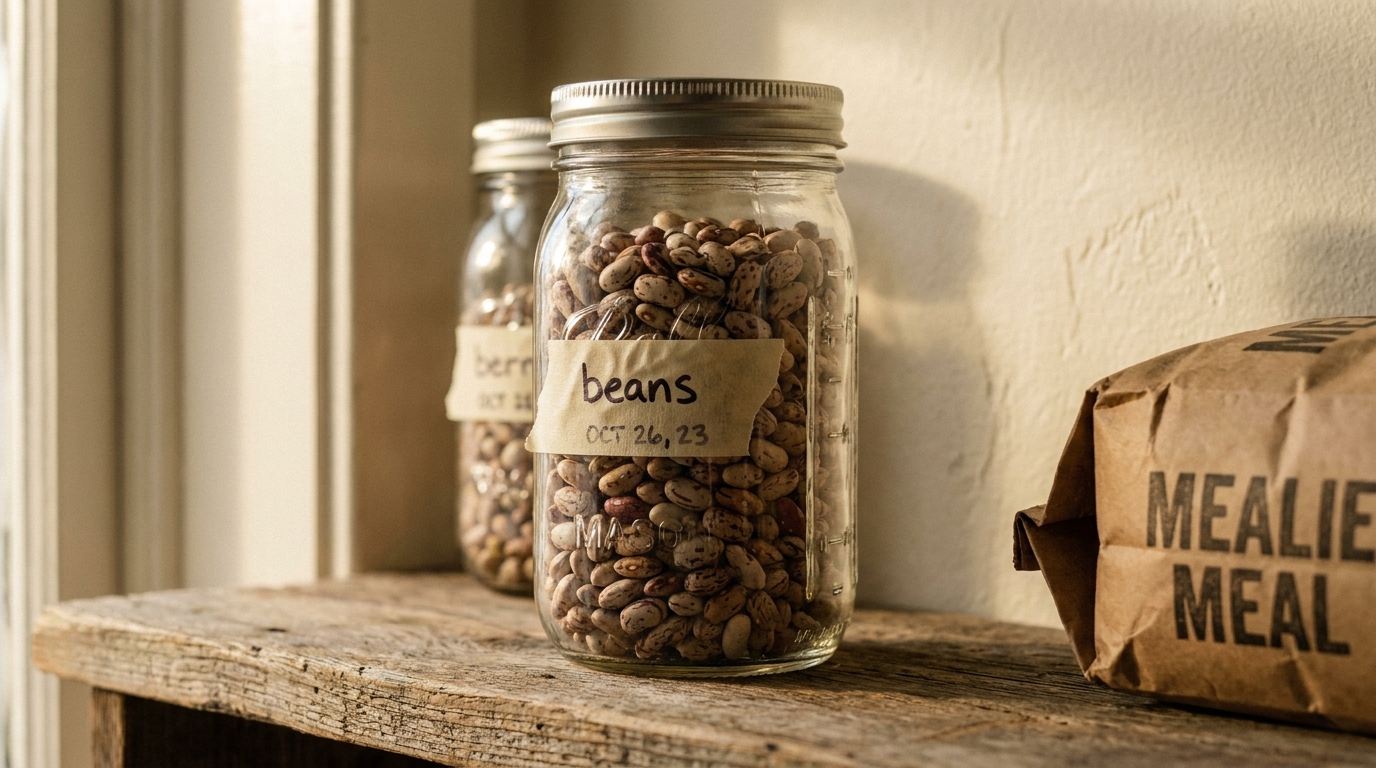
- Decant where it matters; leave-in-pack where it doesn’t. Glass mason jars or sealed containers for anything you have opened. Original packaging, double-bagged where the package is paper, for sealed inventory. Decanting everything is a styled-magazine impulse and is unnecessary; decanting only what’s been opened is what actually keeps food good.
- Label and date. A masking-tape strip on the lid with the contents and the month it was opened. That is enough. You do not need a system; you need a date.
That is the method. The next two sections answer what to put in it and how much it costs.
Building the 30-day pantry
What follows is a working list for a household of four, assuming roughly the same eating patterns most South African suburban households have — three meals a day, mostly cooked at home, a mix of starches and proteins, a respectable but not obsessive interest in vegetables. Adjust quantities for households of two or six; the structure stays the same.
Starches and grains carry most of the calories. For thirty days at four people you want roughly: 5–7 kg of rice, 5–7 kg of mealie meal, 2 kg of samp, 1 kg of pasta, 500 g of oats, 500 g of self-raising flour, 500 g of cake flour. Pack-size up where the supermarket pricing rewards it — typically the 5 kg or 10 kg bags carry the discount.
Proteins and pulses carry the rest of the calorie load and most of the household’s variety. For thirty days at four: 1 kg of dried lentils, 1 kg of dried sugar beans, 1 kg of dried split peas, 6–8 tins of pilchards, 4–6 tins of tuna, 4–6 tins of bully beef or chakalaka with mince. If your household eats meat, plan freezer space for the equivalent of fifteen meals — rough rule of thumb is one large roasting joint, six packs of mince, and four packs of chicken pieces, all bought on rotation.
Fats and basics are the surprise category — they carry less calorie weight than starches but they spoil faster and they are what makes the rest of the pantry edible. For thirty days at four: 1.5–2 L of sunflower or canola oil, 500 g of butter (frozen), 500 g of margarine, 500 g of salt, 1 kg of sugar, 200 g of ground coffee, 100 bags of tea, 250 g of bicarbonate of soda, 500 g of yeast (frozen, in small portions).
Dairy and equivalents are the trickiest tier. Long-life milk in 1 L cartons is the obvious win — 8–10 cartons. UHT cream, 2–3 cartons. Hard cheeses for the freezer; tinned condensed milk, 2 tins; powdered milk for emergencies, 500 g. Fresh milk and yoghurt remain on the weekly rhythm; the pantry handles the buffer, not the every-day.
Vegetables and fruit are a small but worthwhile tier. Tinned tomatoes, 6–8 tins. Tinned beans (any preparation the household eats), 4–6 tins. Tinned fruit, 2–4 tins. Onions, garlic, and potatoes, stored in a cool dark place, 2–3 weeks of supply. Frozen vegetables, 4–5 kg, in a chest freezer or freezer drawer.
Preserves and condiments carry flavour, which is what turns a pantry into a kitchen. Vinegar, 750 ml. Soy sauce, Worcestershire sauce, mustard. Honey, 500 g. Jam, 2 jars. Peanut butter, 1 kg. Dried herbs and spices the household actually uses, in small quantities, replaced as they are used up. We have repeatedly seen 30-day pantries that contained no spices on the assumption that “they are luxuries”; this is the wrong framing — spices are what makes thirty days of stored food eatable.
For a household of four, in mid-2026 South African pricing, this list runs roughly R3,500 to R5,500 depending on what your household eats and where you shop. The PMBEJD Household Affordability Index is the public reference for current monthly basket costs; consult it for the latest figures specific to your closest urban centre.
Extending to 90 days
The honest way to extend a 30-day pantry to ninety days is not to triple the volume of everything in it. That doesn’t work — you would run out of shelf space, the perishables would not survive, and the rotation discipline that kept the 30-day version honest would collapse.
The 90-day pantry is structured differently. Roughly half the volume is held in the rotational layer (the supermarket method, identical in shape, just at slightly larger pack sizes). The other half is held in a deep layer: longer-life staples, sealed against air and light, that you do not rotate as aggressively. Long-life starches go here — additional rice, additional mealie meal, additional pasta — sealed in food-grade buckets or vacuum-bagged in roughly weekly portions. Tinned proteins extend here — cases rather than tins. Dehydrated vegetables join here, if you make them or buy them. The freezer load extends — a chest freezer becomes a much more useful piece of equipment at the 90-day tier than at the 30-day tier.
The 90-day pantry roughly doubles the cost and roughly triples the storage footprint of the smaller version. The 30-day pantry is the version most households should start with; the 90-day version is the version they earn. A working household-of-four 90-day pantry runs roughly R8,000 to R14,000 in startup, with a sustained rotation cost equivalent to about 20% above normal grocery spend until the rotation is trained. After roughly a year of running the discipline, the extra rotation cost falls towards zero — you are eating what you bought, you are buying back what you ate, the system is self-sustaining.
The honest answer to “is ninety days worth doing if you’ve already done thirty?” is yes, with caveats. It is worth doing if (a) you have the storage, (b) you have run the 30-day version for at least three months and proven the rotation discipline, and (c) you are willing to think of the supermarket trip as the maintenance cycle rather than the resupply cycle. It is not worth doing if you cannot satisfy any of those conditions. A failing 90-day pantry is worse than a working 30-day version, because the failure mode is buying food that goes off and being demoralised by the loss.
The year-of-food question
The deepest tier of the spectrum is the year-of-food question, and we want to be careful about how we frame it.
Year-of-food makes sense for a specific kind of household — and almost always for a household that has already run the basic version for a year and a 90-day pantry for another year before considering it. The criteria are clearer than the consensus prepping content acknowledges. It makes sense if you have land, household members at home most of the time, and a clear scenario in mind that justifies the additional storage. Rural households, agricultural-disruption-aware households, households who lived through extended supply-chain interruptions in living memory and decided once was enough — these are the households for whom year-of-food is a defensible choice. For a townhouse household whose nearest threat scenario is a three-week disruption, year-of-food is the wrong tier; the right tier is the 30-day or 90-day version.
The structure of a year-of-food pantry is different again. Roughly a third remains in rotational supermarket form. Another third sits in deep-layer sealed staples, oxygen-absorbed and mylar-bagged in long-life form. The final third is preserved — home-canned, dehydrated, smoked, salted, fermented — and represents the genuine bridge to the homesteading side of the spectrum.
This is the point at which safety-critical preservation work begins to matter, and where we want to be cautious. Pressure canning of low-acid foods — meat, beans, vegetables — has narrow safety margins, and the consequences of getting it wrong are serious enough that we will not attempt to teach the technique inline. The standing references are the USDA Complete Guide to Home Canning and the National Center for Home Food Preservation. Cite them by name. Use their tested recipes. Do not improvise on processing times, acid levels, or jar sizes. We will write a dedicated cluster post on safe pressure canning (pressure canning without killing anyone) — until that piece exists, the safest move is to read the NCHFP guide directly and to take a hands-on workshop with someone competent before you do this for the first time.
The same caution applies to water. A year of food without water storage is not a year of food; it is a year of dry powder. The WHO drinking-water guidelines are the standing reference on safe water, and household water storage is its own discipline with its own failure modes. We will cover this in the dedicated cluster post on water storage; for now, the rule of thumb is fifteen litres per person per day for full needs, three litres per person per day for survival minimums, and the year-of-food household needs serious storage at both ends of that range plus a treatment plan.
The honest cost range for a household-of-four year-of-food pantry, in mid-2026 South African rand, is wide — roughly R30,000 to R80,000 in startup, depending on how much is preserved versus stored, how much is grown versus bought, and how much specialist equipment (pressure canner, dehydrator, deep freezer, food-grade buckets, mylar bags) the household has already invested in. The maintenance cost falls below the equivalent supermarket spend over time, because the preserved component is essentially the household’s grown food in storage form. The labour cost is real and rises significantly. We address that labour calculation in the productive homestead cornerstone, which is the natural companion to this one.
What this looks like, by scale
The 30-day pantry transposes to all three of the Three Scales of Self-Reliance, with shifts in storage form and ceiling at each scale, but the storage form, the costs, and the practical ceilings shift materially.
Townhouse and apartment
Storage is the constraint. The pantry for a household of two or three fits under a bed and across two kitchen cupboards if you choose carefully — rotational supermarket goods in slightly larger pack sizes, a small freezer drawer worth of frozen staples, a small box of long-life buffer (long-life milk, tinned proteins, oats). Ninety days is the practical ceiling for most flats and requires deliberate cupboard reorganisation to achieve without taking over a living space.
The single highest-leverage move at this scale is cupboard visibility — being able to see what you have, when you have it, without unpacking three things to check. Spend the R300 it costs to put proper shelf-stacker bins in place; it is the difference between a pantry that rotates and a pantry that grows mould in the back corner.
What to skip at this scale: bulk dried beans (you don’t have the storage and you don’t have the rotation volume), long-life mylar-bagged staples (storage misallocation), specialist preservation equipment (no kitchen space for it).
Suburban property
The most common case and the one most of this piece is calibrated to. A 90-day pantry fits in a spare cupboard or section of a garage; year-of-food fits with deliberate planning — a dedicated pantry corner, a chest freezer, a small section of garage shelving for the deep layer. The pantry doubles as the everyday kitchen, naturally.
The single highest-leverage move at this scale is rotation discipline. The shelf labelling, the FIFO order, the monthly inventory walk. None of it is hard; all of it requires that the household does it. The first failure mode at the suburban scale is not running out of space; it is running out of attention.
What to skip at this scale, until you have proven the 30-day version: deep-layer mylar bags, pressure canning equipment, a chest freezer dedicated to preservation. Earn the next tier by running the previous one for at least three months without rotation failures.
Rural plot
Volume is not the constraint; shelf-life management and rodent control are. A rural-plot 90-day pantry is the floor; year-of-food is the normal practice. The leverage at this scale is that the pantry is part of a larger system that includes growing, preserving, and storing the household’s own food — what you store, what you grow, and what you preserve are three sides of one operation.
The single highest-leverage move at this scale is pest exclusion. We have personally lost more stored food at the rural scale to mice, rats, and pantry moths than to any other failure mode combined. Steel-bin storage for grains, tight-fitting lids, regular inventory inspection, and a non-toxic pest plan that does not contaminate stored food are the discipline that keeps the year-of-food pantry honest.
What to skip at this scale: the assumption that because you have land, you have food security. Land alone does not guarantee storage; storage requires the same discipline at any scale. We have visited rural plots whose stored food was less rotation-disciplined than the suburban pantries half a kilometre down the road.
Common failure modes
The 30-day pantry, the 90-day pantry, and the year-of-food version each fail in remarkably consistent ways. The failures of the entry tier are particularly worth naming, because that is the version most households are running. The catalogue:
- Bulk-buying without rotating. The classic. The household buys six months of rice in one go, puts it in the garage, and forgets about it. By the time anyone remembers, the rice has weevils, the bag has rodent damage, and the household has learned an expensive lesson that mostly says “don’t try to skip the rotation step.”
- Forgetting cooking fuel and water. A year of stored food assumes you can cook it. If your stove runs on electricity and you have no plan for the grid going down, your year-of-food pantry is — under that scenario — a year of cold cans.
- The freezer no one inventories. Freezers fail silently. A monthly inventory walk catches both the contents drift and the appliance drift before either becomes a problem.
- Pantry-moth infestations. A single moth-infested bag of flour will, given six months, contaminate every cereal product in the room. The countermeasure is sealed glass jars or food-grade plastic for everything cereal-based, and quarantine of any new dry goods (a week in the freezer kills moth eggs before they hatch in your pantry).
- Rodent damage in rural storage. Already mentioned, worth repeating. Steel bins. Tight lids. No paper or cloth bags in long-term storage.
- The seal that turned out not to have been a seal. Home-canned food whose lid did not pop is contaminated and dangerous. The discipline is test every lid and discard ruthlessly. NCHFP guidance is unambiguous on this; do not improvise.
- Growing kale that no one in the household eats. This is a homesteading-side failure mode that bleeds into the pantry side; it is worth flagging here because we have seen 30-day pantries weighed down by tinned or preserved produce that the household genuinely does not enjoy. Buy what you eat. Store what you eat. Grow what you eat.
- Pressure canning improvisation. The single most dangerous failure mode in this entire piece. Do not improvise processing times. Do not substitute jar sizes. Do not modify acid levels in tested recipes. Botulism does not announce itself; it kills. The standing references are NCHFP and USDA, and if you cannot find a tested recipe for what you want to preserve, the answer is don’t preserve it that way.
If two or more of these describe your kitchen, you are in good company. The point of writing them down is to make them visible, in the same way the threat assessment walkaround makes vulnerabilities visible. The pantry is a parallel exercise in honest stocktaking.
What to do next
The output of this piece is meant to be a list that lets you build the pantry — not a feeling, not a half-formed intention, an actual list. Today, this weekend, before the next supermarket trip, write a working week’s meals for your household. The seven dinners and the rough lunches and breakfasts. Multiply by four to scale to a month. Walk the supermarket with that list, calculate the cost, identify what fits in your existing cupboards and what doesn’t, and decide whether the entry tier is the right starting target.
If you already have a working 30-day pantry that you have been rotating for at least three months, the next decision is whether the 90-day version is worth the additional storage and discipline. The 30-day pantry is the proving ground; the 90-day pantry is the next tier. The answer is probably yes for suburban and rural households, probably no for townhouse households, but the household-specific answer is yours to make.
If you are at year-of-food already, the question is no longer the pantry — it is whether your water storage, your cooking fuel plan, and your preservation safety practice match the depth of the food storage. The pantry is the part that is easiest to see; the surrounding system is the part that determines whether the pantry is actually useful.
Re-evaluate every ninety days. Walk the shelves. Check the dates. Eat what is approaching its end. Buy what you ate. Repeat.
Take the shopping list with you. If you want a printable version of the list above — three tiers, real quantities, May 2026 South African pricing, the brand examples, and the “what NOT to buy” notes — we’ve packaged it as a free downloadable PDF you can take to the supermarket. One short email gets it to your inbox.
Sources cited in this piece
- USDA Complete Guide to Home Canning — the standing reference on water-bath and pressure canning. Cite by name on every safety-critical preservation claim.
- National Center for Home Food Preservation — companion to the USDA guide and the standing primary source on safe home preservation.
- PMBEJD Household Affordability Index — Pietermaritzburg Economic Justice & Dignity, monthly tracking of the South African household food basket.
- WHO Guidelines for Drinking-water Quality — the international authority on safe drinking water; cited because food storage without water storage is incomplete.
- Provident Living — long-tradition organisational guidance on long-term staple storage, cited neutrally for methodology.
Start with the 30-day pantry. Run it for three months. Then decide what’s next.
— SOURCES
-
United States Department of Agriculture Complete Guide to Home Canning — the standing reference on water-bath and pressure canning for home use. Authoritative on processing times and safety margins for low-acid foods.
-
National Center for Home Food Preservation — companion to the USDA guide and the standing primary source on safe home preservation. Cited by name on every safety-critical claim involving preservation.
-
Pietermaritzburg Economic Justice & Dignity Group — monthly Household Affordability Index tracking the cost of a standard South African household food basket. Reference for grounding food and homestead costs in current rand.
-
World Health Organization Guidelines for Drinking-water Quality — the international authority on safe drinking water. Cited on any claim about water testing, treatment, or what makes household water actually safe.
-
The Church of Jesus Christ of Latter-day Saints, Long-Term Food Storage Recommendations — seventy years of organisational practice on long-term staple storage at household scale. Cited neutrally for methodology, not endorsement.
— FURTHER READING

Canning for Beginners: A Proven Safe Start Guide
Canning for beginners made safe and simple: learn water-bath vs pressure canning, what to preserve, and the science behind sealing food that keeps for years.

How to Store Rice Long Term: A Proven Guide
How to store rice long term the right way — proven, evidence-led methods to keep rice fresh for 10-25 years in South African conditions, without the hype.

Dried Food: The Complete Guide to Home Preservation
Dried food is one of the cheapest, most reliable ways to build a calm food store. Learn methods, shelf life and safe drying for South African homes.