— SECURITY
Threat assessment: an honest, five-question home walkaround

— ON THIS PAGE
The first skill in any serious approach to home security isn’t a product, a system, or a policy. It’s the ability to look at your own house and answer one question honestly: what would I actually do, if someone tried to come through that door right now?
Most people can’t. That isn’t a failure of imagination — it’s a failure of having ever done the work. Threat assessment is the work. It is the structured, deliberate exercise of looking at your home, your property, your routines, and your assumptions, and identifying where they are thin. We do it before recommending products, alarms, fences, dogs, or any of the gear the security industry would prefer to sell you, because all of that gear is wasted on a house whose owner hasn’t first asked the questions in this piece.
Threat assessment is also the most underrated skill in the entire field of home security, and a serious one is the work that distinguishes a household with security from a household with security theatre. Done well, it costs nothing and produces an enormous return: a clear-eyed view of where your real vulnerabilities are, in priority order, so the time and money you spend afterwards goes where it actually matters. Done poorly, or not at all, you end up with a security camera covering the most photogenic angle and nothing watching the side gate.
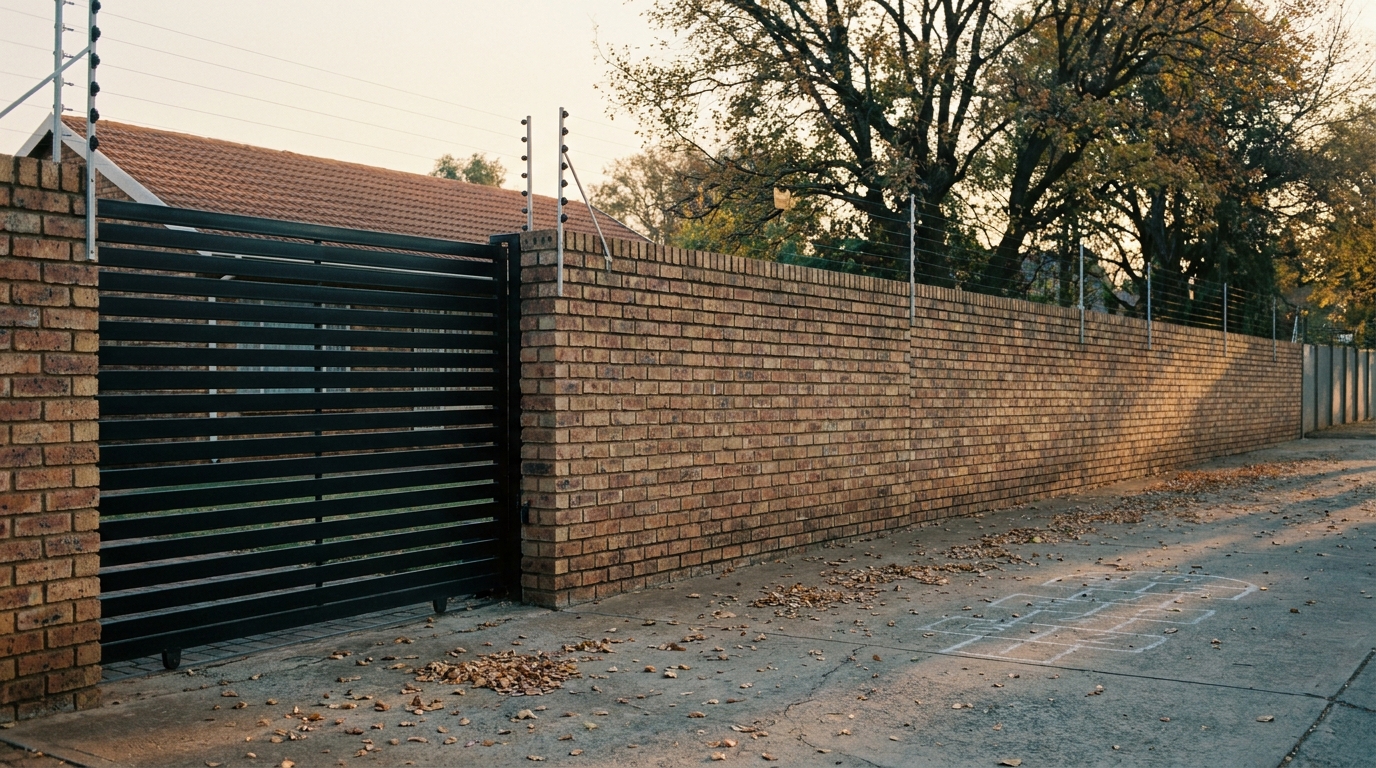
This piece is the long version of the threat assessment we run with every household before a single product enters the conversation. Done seriously, it costs nothing but the time it takes. It is method, not gear. It is written by people who have done this work as a profession — and who would tell you, plainly, that nothing on a shelf in a security shop will help you if you haven’t first done the walkaround you are about to do.
What this isn’t
Before defining what the work is, it is worth being clear about what it isn’t, because the term gets used loosely and lazily.
It isn’t a list of statistically common crimes, lifted from a national dataset and applied to your house. The base rate of “burglary” in your country tells you very little about your specific risk. Your specific risk is shaped by your specific neighbourhood, your specific routines, your specific property, and your specific household. Published figures from SAPS or any equivalent are a starting point at best — they describe everything that happened to everyone last year, smeared across a country. They do not describe what is most likely to happen to you, on your street, this year.
It isn’t a list of imagined worst cases either. “What if a coordinated team of armed intruders breached the perimeter at three in the morning” is a fantasy, not an assessment. The vast majority of property crime is opportunistic, low-skill, and quick — the academic literature on routine activity theory has held this up consistently since the late 1970s, and the SAPS station-level statistics tell the same story when you read them honestly. Planning for the cinematic worst case at the expense of the actual most-likely case is the single most common error in amateur security thinking, and it is what makes most prepping content on this subject useless.
And it isn’t a security audit done by a stranger. A consultant can be useful, but the person best placed to assess your specific risk is you, because you know things about your house and your routines that no consultant ever will. You know which window your daughter leaves open in summer. You know which neighbour you’d actually phone in a crisis. You know what time you genuinely get home on a Tuesday, not what time you tell people you get home. The work is something you have to do yourself, even if you later get a professional involved.
There is one more thing it isn’t: it isn’t theatre. It is not buying an alarm-system sticker without an alarm. It is not pointing a camera at the photogenic angle. It is not the half-hour conversation about a panic button no one in the household can locate from memory. Done seriously, the work asks honest questions — and the answers must be allowed to be inconvenient.
The five questions
Threat assessment, at its most useful, is five questions answered seriously about your specific circumstances. The questions are simple. The answers, if you are being honest, almost always reveal at least one weak point you weren’t tracking. The discipline is in not flinching when the answer is awkward.
1. What are the realistic threats?
Not the imagined ones. The realistic ones. For most households, in most places, the realistic threats are, in rough order of probability:
- Opportunistic property crime — burglary, vehicle theft, theft of items left visible. The most common threat by an order of magnitude. The offender is not specifically targeting you; they are walking past, scanning, and moving on or stopping based on what they see in the next ninety seconds.
- Targeted property crime — someone who has specifically chosen your house, usually because they have observed something that suggests value, vulnerability, or routine. This category is much smaller than the first, but the consequences are more serious, because the offender has thought about you specifically.
- Domestic and interpersonal threats — an estranged former partner, a disgruntled former employee, a person known to a household member. These threats look completely different to the property-crime case and are addressed completely differently. Many households who would never tolerate a stranger on the property quietly tolerate a known threat from inside their own social network.
- Crimes of access during legitimate-seeming visits — a delivery person, a tradesperson, a door-to-door caller using the visit to assess the property for a later return. This is more common than households assume and is precisely the kind of threat that no amount of fencing or cameras addresses.
- Wider unrest — civil disturbance affecting a neighbourhood broadly. Geographically variable; in some places, the dominant concern. In South Africa specifically, the July 2021 unrest reframed how a generation of households think about preparedness, and not always in useful ways.
Reasonable people in different places weight these differently. Someone living in a quiet suburb of central London weights opportunistic property crime higher than wider unrest. Someone living in a region where civil disturbance has happened in living memory weights it higher. The right weighting is the one that matches your actual circumstances, not the one that matches the most dramatic prepper-blog scenario you read at two in the morning.
A note for South African readers: the SAPS quarterly figures are publicly available and worth reading at least annually for your own station’s catchment area. Read them honestly — note both what is going up and what is going down — and resist the urge to round up to the worst neighbourhood in the country and then plan for that.
2. What’s actually attractive about your property?
From the perspective of someone who is not you. Walk to the street. Look at your house the way a stranger would, on a slow walk past, in fading light, on a Tuesday. What can they see? What does it tell them?
A house with a recently delivered courier package on the porch tells them you order things online and you are not home. A house with the same car in the driveway every weekday between nine and five tells them when you are home and when you are not. A house with high-end gym equipment visible through a window tells them what is worth taking. A house with an alarm-system sticker — but no actual alarm, because half of “alarm system stickers” are bought separately to bluff burglars — tells them you have thought about security but have not actually done much. (This last one is real, and the bluff stops working when burglars test it; we have seen this fail more than once.)
A house with rubbish bins put out the night before pickup, visible from the street, dressed with the household’s last fortnight of consumption — courier boxes, takeaway packaging, the wrapping from a new appliance — has just published an inventory. A house whose Wi-Fi network name is the family surname has connected the household to the address.
The exercise of standing at the street and writing down, plainly, what your house signals to a stranger is usually the first eye-opening moment of the exercise. The walkaround begins from outside, on the pavement, the way an unwelcome visitor would begin theirs. We have walked properties with owners who genuinely believed they were unremarkable and watched their faces when we listed back, in order, the seven specific things their property told an attentive observer in under a minute. None of those owners were careless people. They had simply never looked from this side of the wall.
3. What are your honest vulnerabilities?
A vulnerability is the gap between what you have planned for and what would actually happen. Vulnerabilities tend to fall into a few categories:
- Physical access points — doors, windows, garages, side gates, fences, and crucially the weakest one. Most properties are defended only as well as their weakest entry, and most households have a weakest entry they have stopped seeing. The kitchen door whose lock has been “a bit dodgy” for two years. The gate that no longer self-latches. The window with the rotted frame upstairs that hasn’t actually been openable from the outside since 2019, or so we believe.
- Sight lines — what you cannot see from inside the house, and what neighbours cannot see from theirs. Burglars love properties with high hedges or walls obscuring the entry from the street; they prefer privacy as much as you do, and for the same reason. The South African love affair with high boundary walls is a genuine threat-assessment problem in this regard, because the same wall that keeps the world out keeps the world from seeing what is happening on your driveway.
- Predictable routines — when you leave, when you return, when the house is empty, when you take the bins out, when the dog gets walked, when the gardener arrives, when the helper leaves. Predictability is itself a vulnerability, and households whose routines are most regular are often the proudest of that regularity.
- Information leakage — what your social media reveals, what your house signals to passers-by, what package deliveries say about your habits, what Google Street View shows about your perimeter, what a Hellopeter complaint about a recent purchase says about what’s now in your house. The internet is wonderfully cooperative with anyone who wants to know things about you that you did not intend to publish.
- Response capacity — what you would actually do in the first sixty seconds of a problem. Not what you imagine you would do; what you have actually rehearsed. We will return to this in question five, because it is so often the thinnest part of a household’s plan.
Be honest. Honesty is what separates threat assessment from theatre, and the honest version is the only kind worth running, and it is also the part most households quietly avoid, because the honest answer is sometimes that the front door has been the weakest point for three years and you have been telling yourself it was on the list.
4. What are your existing strengths?
Often overlooked. People conducting their first threat assessment fixate on what is wrong; the more practiced eye notices what is already working, and miss what is already working. Strengths might include: a neighbour who is home most of the day; a dog that barks at strangers (and a dog that doesn’t — equally important to know); a road that is busy enough to make property crime uncomfortable; a security industry response company in your area with a credible response time and a PSiRA-registered status you can verify; a household member who works from home; a yard whose layout naturally funnels approach to a single, observable point; a streetlight directly outside the gate that you have not, in fact, broken.
Listing strengths matters because the goal here is to identify where to invest, and investment goes against weak points — not against strong ones. Adding a security camera to a corner that your neighbour can already see is wasted money. Hardening a door that is already overbuilt while ignoring the door three metres away that is not is a misallocation.
There is a softer category of strength worth acknowledging too: the household’s own competence. A household that has rehearsed a plan, knows where the torches are, and has actually walked the property at night in the last six months is genuinely safer than one that has installed twice the equipment without doing any of those things. Competence is a security strength, and it is one you build for free.

5. What would your first sixty seconds actually look like?
If something happened — right now, today, while you are reading this — what would you do? Where is your phone? Where are the people you care about? Do they know what to do? What is the meeting point? Who is the first call? What is the second one if the first does not pick up?
Most people have never thought through their first sixty seconds in any concrete way. The work of doing so is not expensive, is not exotic, and produces more genuine resilience than any amount of equipment.
The honest answer for many households is something like this: the phone is on the kitchen counter, my partner is upstairs, the children are in the lounge, the dog is in the garden, I would probably shout, I am not sure what I would do next, I have never actually phoned the response company so I do not know what they ask for, the meeting point if we ever needed one is — I think — the kitchen, although we have not discussed this since we moved in.
Read that again. That is not a plan. That is the absence of a plan, written down. The exercise of writing it down — actually writing it on paper, from memory, without consulting the rest of the household — is what surfaces the gap.
A useful first-sixty-seconds plan answers four questions in order: where am I now, where is everyone in the household, what is the first communication, where do we converge. It is rehearsable. It is the household equivalent of what fire drills were for, before everyone forgot what fire drills were for.
What this looks like, by scale
The walkaround above applies universally in shape, but the answers — and the highest-leverage moves — differ materially across the Three Scales of Self-Reliance. A threat assessment for a townhouse is a different exercise from one for a rural plot, even though the questions are the same. An approach that is correct for a townhouse will be wrong for a rural plot, and vice versa. The shape is the same; the priorities are not.
Townhouse and apartment
There is no real perimeter to assess. The body corporate or the building owns the entry. What you assess instead is the interior layer — your front door, your windows, your balcony, your parcel handling, your relationships with the people who control the common areas.
The single highest-leverage move at this scale is almost always the front door. A standard South African residential security door, fitted competently, is a different category of obstacle to an unhardened door, and it is the obstacle that will actually face an opportunistic intruder. If your door is standard, that is your first investment, ahead of any camera or alarm.
The second-highest-leverage move at this scale is the visitor protocol — who you let into the lift, who you buzz in, what your delivery process looks like. Many flats are entered by people who were waved through at the gate by a polite neighbour.
What to skip at this scale: high-end perimeter electronics, expensive outdoor cameras, dog deterrents (you are not allowed). These are theatre at a townhouse level. The investment goes inside the door.
Suburban property
The classic case. The perimeter exists but is permeable. The walkaround is exterior-first: the street-side signal, the sight lines, the weakest entry, the side gate, the dog, the relationship with the neighbours.
The highest-leverage move at this scale is almost always fixing the weakest entry, not adding a new layer to the strongest. A R2,000 Trio-lock on a side gate that no one notices does more for your security than a R30,000 camera system pointing at a front gate that a serious intruder would not approach anyway.
The second-highest-leverage move is sight-line hygiene — the boundary wall that is too high, the hedge that has grown in over a decade, the corner of the garden that no one can see from anywhere in the house. This is mostly free; it is mostly a Saturday with a saw and a willingness to lose some privacy in exchange for genuine visibility.
What to skip at this scale: ten cameras when three would do; reinforcement of an already-strong front door at the expense of the kitchen door; expensive monitoring contracts before you have verified that your nominated response company is actually PSiRA-registered, currently trading, and has a real response time in your area.
Rural plot
The hardest case, and the one most prepping content gets wrong. The perimeter is real but it is also vast — the boundary fence of a one- or five- or ten-hectare plot is, by definition, indefensible in the way a townhouse door is defensible. You cannot harden the whole perimeter, and pretending you can is a losing strategy.
What you can do — and what the work for a rural plot is structured around — is detect early and respond quickly. The dominant constraint is no longer access; it is response time. By the time anyone responds, the question is what someone has had time to do or take.
The highest-leverage moves at this scale are detection — driveway sensors, motion lighting that actually works in winter, dogs that bark at distance and that you can read accurately, and a household plan that begins with information rather than reinforcement. Did the dogs bark twice or four times. Was the driveway sensor a bushbuck or a person. The bedroom light at the cottage just came on at an unusual time. These are the inputs of rural assessment.
The second-highest-leverage move is a rehearsed first-sixty-seconds plan that accounts for the fact that armed response, if it exists at all, is twenty minutes away. The plan must be self-reliant for those twenty minutes. That is a very different plan from the suburban one.
What to skip at this scale: token perimeter reinforcement (a single strand of barbed wire on a kilometre of fence does nothing); cinematic concealment plans; equipment that requires a working internet connection during an event you have not pressure-tested for the case where the internet is the first thing to go.
Common failure modes
Threat assessments fail in remarkably consistent ways. We have seen each of these more times than we care to count:
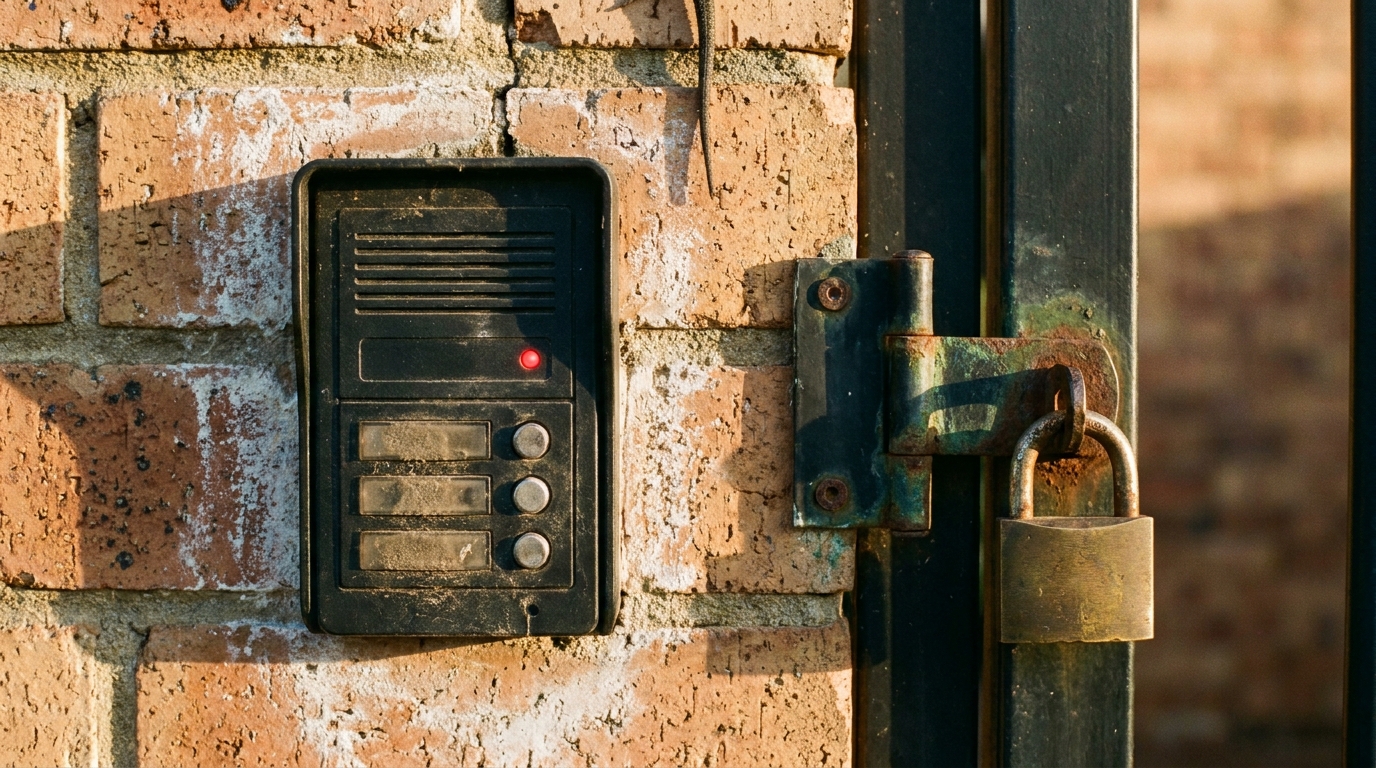
- The alarm-system sticker without an alarm. A bluff is not a plan. The first time the bluff is called, it is also the last time. If you have stickers, you should also have the system; if you do not have the system, the stickers are an active liability.
- The camera at the photogenic angle. A camera covers what it covers. If it covers the front door from the street, it does not cover the side gate, regardless of how impressive the front-door footage looks at the next dinner party.
- The panic button no one can locate from memory. If three members of the household cannot, right now, point at where the panic button is without thinking about it, the panic button is a decoration.
- The second key under the rock. This is not a security measure. It is a measure to ensure that anyone who is patient enough to watch the house gets in.
- The dog who has stopped barking. Animals habituate. A dog who used to bark at every passing stranger and now barks at none has learned that barking does not produce attention. That dog is not a deterrent. It is a pet, which is fine — just do not include it under the wrong category.
- The contract with a security company you have not actually verified. A surprising number of households have an active monthly debit order with a company whose PSiRA registration has lapsed, whose response patrols no longer cover their suburb, or who quietly subcontract response to a third party they have not disclosed. Verify, in writing, with PSiRA and with the company.
- The plan that exists only in one head. An assessment that lives only in the mind of the household member who wrote it does almost nothing. The other members must know it. The first-sixty-seconds plan is a household plan, not a personal one.
- The reinforcement creep that ignores the weakest entry. If you can list, off the top of your head, the seven security upgrades you have made to the front of the house and zero upgrades you have made to the back, you have a problem you have not been seeing.
If you recognise yourself in two or more of these, you are in good company. Most households do. The point of the exercise is exactly to make these visible. The point of writing them down is to make them visible.
What to do next
The output of a threat assessment is not a feeling. It is a list — three to five concrete vulnerabilities, in priority order, that you have decided are worth addressing in the next ninety days. From there, the rest of security work is comparatively easy. You know what to fix, you know in what order, and you stop spending money on things that don’t address what you’ve identified.
Today, if you have read this far: walk your property. Take a notepad. Stand at the street first, look at your house the way a stranger would, and write down what it tells them. Then walk the perimeter. Then enter as a stranger would, paying attention to the route they would take and the route you actually take. Write the answers to the five questions, by hand, on paper. Identify the worst one. Fix that first.
We will cover the cluster pieces — hardening the weakest entry, sight-line and lighting work, the family first-sixty-seconds plan, and verifying a response company — in companion posts. They sit alongside this one. None of them matter until the assessment is done.
Re-walk the property in ninety days. A threat assessment is not a one-time exercise; it is the foundation that everything else is built on, and the assessment that you re-walk every ninety days is the one that stays accurate. The realistic threats most households face are addressed by a small number of unglamorous, inexpensive measures, applied consistently. The genuine work of security is repetitive and quiet. It rarely involves the products that get the most attention. It almost never involves the products with “tactical” in their name.
Do the threat assessment. Make the list. Fix the worst one first. The rest is detail.
Take the worksheet with you. If you want a printable version of the walkaround — the five questions as a fill-in form, with scale-by-scale scope notes and a findings-priority matrix — we’ve packaged it as a free downloadable PDF you can fold into a back pocket and carry around the property. One short email gets it to your inbox.
Sources cited in this piece
- SAPS quarterly and annual crime statistics — South African Police Service, station-level figures by crime category. Read these honestly for your station’s catchment.
- International CPTED Association — the method authority on Crime Prevention Through Environmental Design, which underpins much of what an experienced practitioner is looking for during a property walkaround.
- NCSC physical security guidance — the United Kingdom’s National Cyber Security Centre publishes concise method-led guidance on physical security planning that maps cleanly to household-scale work.
- Cohen and Felson, Social Change and Crime Rate Trends: A Routine Activity Approach (1979) — the foundational academic paper underlying our framing of opportunistic crime as a function of motivated offender, suitable target, and absence of capable guardian.
- PSiRA — Private Security Industry Regulatory Authority — the South African regulator. Verify any security company you contract with, in writing, before signing.
If you found this piece useful, the place to start your own work is at the front of your house, with a notepad, and an hour. The first one is also usually the most revealing. Everything else is downstream of that.
— SOURCES
-
South African Police Service — official annual SAPS crime figures by station and category. Useful for grounding base-rate intuitions, not for predicting specific risk to your specific household.
-
International Crime Prevention Through Environmental Design Association — the method authority on how physical design (sight lines, lighting, access control, territorial reinforcement) changes how a property invites or deters approach.
-
UK National Cyber Security Centre — concise, well-structured method-led physical security guidance from a serious public authority. Maps cleanly onto household-scale assessment.
-
Social Change and Crime Rate Trends: A Routine Activity Approach (American Sociological Review, 1979) — the foundational academic paper on opportunistic property crime as a function of three converging conditions.
-
Private Security Industry Regulatory Authority of South Africa — the regulator for private security companies. Useful for verifying that an armed-response or security firm is registered and in good standing.
— FURTHER READING

Home Perimeter Security: A Practical, Calm Guide
Home perimeter security done calmly: layered deterrence, real deterrent evidence and a sensible sequence for South African smallholdings and suburbs.

Home security: where to start, what to skip
Home security on this publication is a method practised in advance, not a product purchased after the fact. Where to start, what to skip, what we’ll write.